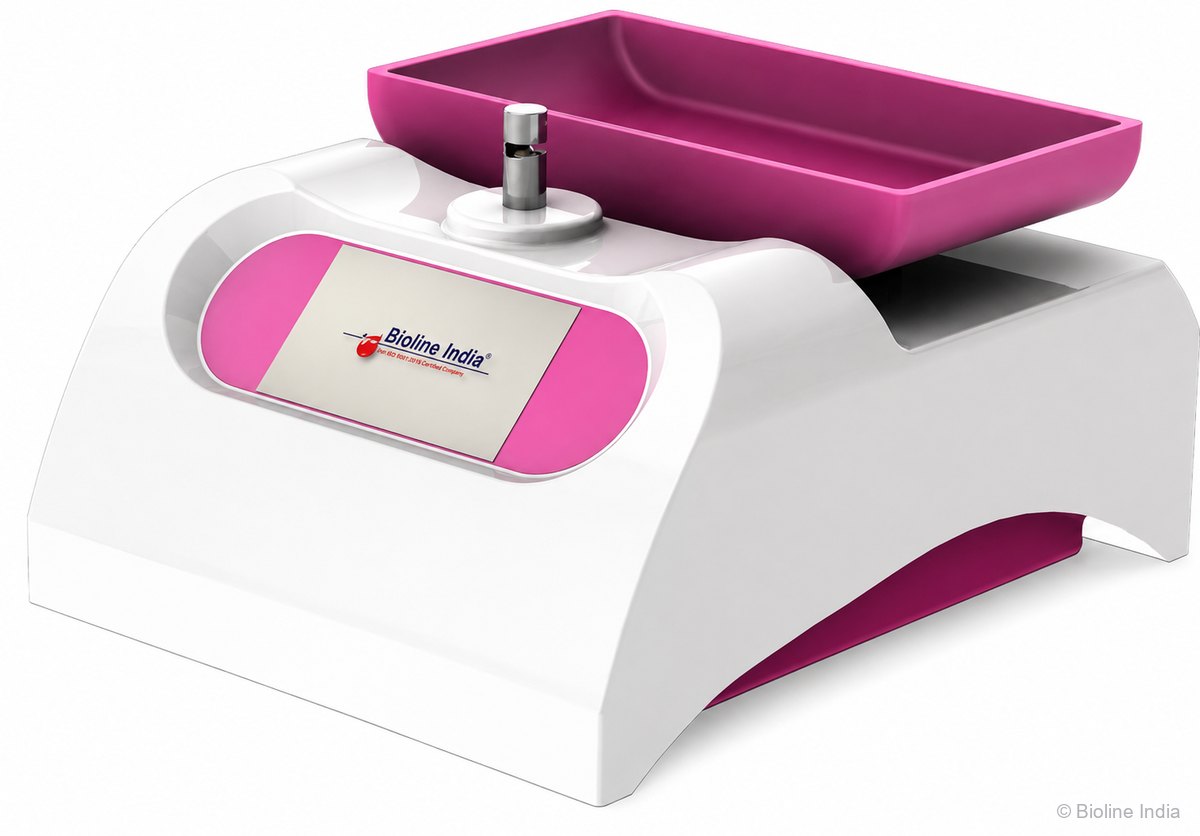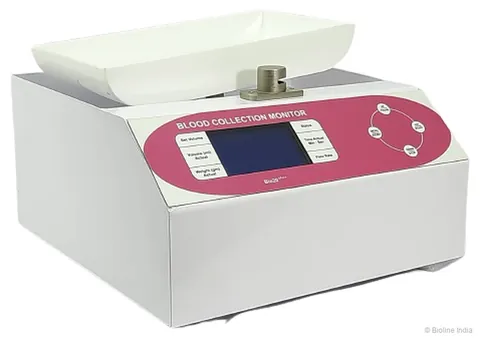
A blood collection monitor sits beside the donor couch and holds the blood bag during donation. It weighs the bag to measure the volume collected, keeps the blood mixed with the anticoagulant, warns staff when the flow is too slow or too fast, and stops the collection at the set volume. A good monitor makes every unit consistent and frees staff to look after the donor.
This guide lists what to check before you buy. Bioline India makes blood collection monitors in Indore, and we use our BioMix 3D and Bio 20 Plus models as examples.
1. How it mixes
Blood must mix with the anticoagulant in the bag throughout the donation. Ask how the monitor moves the bag and how often.
- Rocking monitors tilt the tray back and forth. Our Bio 20 Plus mixes gently at 12 to 20 cycles a minute.
- 3D orbital monitors move the tray in a circular, three dimensional motion. Our BioMix 3D uses 3D orbital mixing and supports all types of blood bags.
2. How accurately it weighs
The monitor works out the volume from the weight of the bag, so weighing accuracy matters. Ask for the stated accuracy and whether it tares the empty bag on its own. The Bio 20 Plus measures volume and weight to within plus or minus 1 ml or 1 g and tares bags from 0 to 999 g. The BioMix 3D adjusts the tare automatically.
3. Setting the volume
Check that common volumes are one touch away and that you can set others. Both our monitors offer 350 ml and 450 ml presets and let you set any target from 0 to 999 ml. The Bio 20 Plus also remembers the last volume for repeat collections.
4. Flow alarms
A slow or fast flow needs attention at once. Look for audible and visual alarms for low and high flow, and for completion. Our monitors alarm when the flow is below 20 ml or above 180 ml a minute. The BioMix 3D also shows a live flow graph and turns red for a flow alert.
5. Stopping at the right volume
The monitor should clamp the tube itself when the set volume is reached, so the bag is not overfilled. Our monitors clamp automatically at the preset volume, and the Bio 20 Plus releases the bag when it is lifted.
6. Battery for camps and power cuts
Donation camps often have no reliable power. Ask how long the monitor runs on battery. The Bio 20 Plus has a 24 hour battery backup, and the BioMix 3D runs for up to 35 hours on its rechargeable lithium-ion battery.
7. Data and barcodes
Records help with traceability and audits. Check whether the monitor stores donation data, reads bag labels and sends data to a computer. The BioMix 3D has a barcode scanner that reads most standard labels, including ISBT 128. It stores donation records and transfers them to a PC with the bag number, volume, date, time and flow graph.
8. Service and calibration
A monitor is used on every donation, so calibration and service matter. Ask how calibration is done and who services the unit near you. The BioMix 3D guides the operator through calibration on screen and runs automatic fault diagnosis. Bioline India installs and services its monitors with its own engineers.
Quick checklist
- Mixing type and speed suit your bags
- Weighing accuracy and automatic tare
- 350 ml and 450 ml presets, and custom volumes
- Low flow, high flow and completion alarms
- Automatic clamping at the set volume
- Battery life for camps and power cuts
- Data storage, barcode reading and PC transfer
- Calibration help and local service
Bioline India blood collection monitors
- BioMix 3D: 3D orbital mixing, 5 inch touchscreen, barcode scanner, PC data transfer, up to 35 hours on battery
- Bio 20 Plus and Bio 20 Plus B: microprocessor controlled, 12 to 20 cycles a minute, plus or minus 1 ml accuracy, 24 hour battery backup
Ask us for a demonstration or a quote.
Pictures