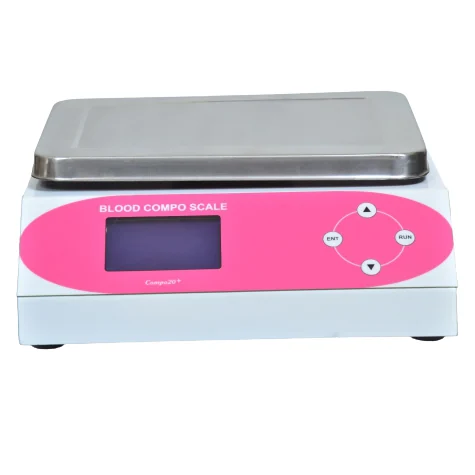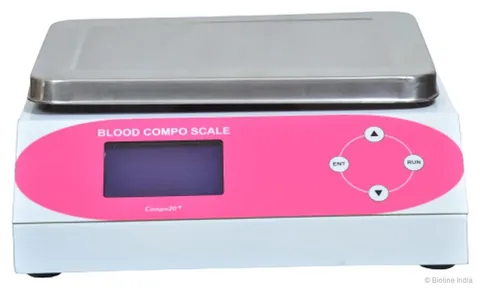
After separation, a blood bank needs to know the volume of each component it has made. Weighing is faster and cleaner than measuring, but each component has its own specific gravity, so the same weight means a slightly different volume for plasma, platelets or red cells. A compo scale does that conversion for you.
Bioline India makes the Compo 20 Plus in Indore. This guide lists what to check.
1. Components covered
Check which components the scale converts. The Compo 20 Plus shows volume and weight for whole blood, plasma, platelets, red cells and white cells, taking the specific gravity of each into account.
2. Tare for the bag
The empty bag must not count as blood. Look for a tare function. The Compo 20 Plus has a tare to account for the weight of the bag.
3. Set volumes
Setting a target volume for each component makes separation more consistent. The Compo 20 Plus lets you set the volume of each component and shows the process value in ml and g.
4. Calibration
Ask how the scale is calibrated and against what. The Compo 20 Plus is calibrated with a master calibrator certified by the Electronic Regional Test Laboratory (ERTL West), a Government of India recognised laboratory, with traceability to the National Physical Laboratory.
5. Display and use
A clear display reduces reading errors. The Compo 20 Plus has a graphic LCD, is light and portable, and also helps balance bags for the refrigerated centrifuge.
Quick checklist
- Converts weight to volume for every component you make
- Tare for the bag
- Set volumes for each component
- Traceable calibration
- Clear display, portable
- Local service
Ask us for a quote for the Compo 20 Plus.
Pictures